Without
recourse. All Rights
Reserved. Tree of Life©
What part responsibility do I take upon myself
towards creating a Seventh-day Adventist
community
characterized by free
speech
while seriously focusing upon, and growing
with, the truths discernable within the Word of God?
Statement of
belief: “Sanctify them through thy
truth: thy word is truth.” (John 17:17 KJV)
Created 5924± 02 02 2020 [2004-04-22]
Updated 5924[(*??*)] 08 06 2028
[2011-12-01]
Revised 5925[(*??*)] 01 14 2029
[2013-04-24] – Changing “the Day of Sabbaths” to “the Day of the Sabbaths,” revising
item #3, and the
rendering of Lev 23:7, 16 TLT.
Revised 5925[(*??*)] 01 19 2029 [2013-04-30] – Complete review with
minor edits under item #7. Revised the last paragraph under item #9.
Revised 5926[(*??*)] 09 26 2030
[2013-12-30] – Revised
my stand re date of Hag HaOmer in the year of the crossing of Jordan.
Revised 5926[(*??*)] 10 14 2030 [2014-01-16] – Alternative stand re date
of Hag HaOmer in the year of the crossing of Jordan.
The Feast of Weeks
-
that is
- a Special Seventh Day Sabbath Set Aside Annually in the
Commemoration of the Many Blessings of the Seventh Day Sabbath
-
also known as
Pentecost
-
The Ante Type for the Cycle of Jubilee
What are some of the reasons that the Children of
have not been “long upon the land”?
According to the Torah the Feast of Weeks is within,
not after, [the Weekly] Shabbat, and
the Year of Jubilee is the Same as, not Subsequent to,
the Last Shabbat Year in the Jubilee Cycle.
Machar haShabat [מחרת
השׁבת] means
“the Morning of the Shabbat” or “the Morrow after the
Beginning of the Shabbat.”
According to
the Torah ante-typical events
each Shabbat year and
each and every year begin with Hag HaAtzeret (the Feast of the Eighth Day,) in
the Seventh
lunar month while it ends with the Feast of Ingathering / the Feast of Tabernacles
of the subsequent Seventh month.
There was no
controversy between the
Jews and the first Christians re the timing of these Shabbat/Sabbatical events.
Even the
prophet Daniel was reckoning the Omer based upon a
Shabbat morning sacrifice.
Thus, the
keeping of Pentecost on Sundays seems, like replacing the Seventh-day Sabbath
with the
Abstract:
In
order to permit the intended lessons inherent in the Day of the Shabbats aka.
the Feast of Weeks, and the corresponding blessings inherent in the
instructions for the cycle of Jubilee years, and as well the promised blessings
of the fifth Commandment, it appears necessary to revise tradition such that it
once again gets in tune with the Torah. The chief errors of current tradition
seem to be that the Waving of the Sheaf, Hag Ha-Omer, and Hag Ha-Shavuot are
both being celebrated on a Sunday rather than upon a Seventh Day Shabbat, and
that, correlating with the before said, the year of Jubilee is considered an
extra year of rest following upon a regular Shabbat year, rather than being one
and the same as the last Sabbatical year in the cycle. These errors stem from starting the count of
days and years one day/year off from their respective bases, while forgetting
the emphasis the Torah always places upon firsts, beginnings, and ultimate
foundations, always being remembered. The Hebrew word pair ‘macharat
haShabat [מחרת
השׁבת] means “the morning of the
Shabbat”, or “the morrow after the eve, the beginning, of the Shabbat”.
I’ve
been impressed with the idea that Hag Ha-Shavuot / the Day of Shabbats / the
Feast of Weeks / Pentecost, as given in the Torah, is, among other things,
intended as an annual reminder and as an instruction for the cycles of
Jubilee. If there were no annual Feast
in reminiscence of the 49 year cycles of Jubilee, it would be exceedingly
difficult for the people to carry forward correctly the instructions re the
year of Jubilee, especially since the year of Jubilee only occurs once or twice
within the lifetime of most people ever since the time of Moses.
First, let’s consider carefully the real meaning of
the Hebrew Torah Passover instructions!:
Lev 23:5 בחדשׁ
הראשׁון
בארבעה עשׂר
לחדשׁ בין
הערבים פסח
ליהוה׃
Lev 23:6 ובחמשׁה
עשׂר יום
לחדשׁ הזה חג
המצות ליהוה שׁבעת
ימים מצות
תאכלו׃
Lev 23:7 ביום
הראשׁון מקרא־קדשׁ
יהיה לכם
כל־מלאכת
עבדה לא תעשׂו׃
Lev 23:8 והקרבתם
אשׁה ליהוה שׁבעת
ימים ביום
השׁביעי מקרא־קדשׁ
כל־מלאכת
עבדה לא
תעשׂו׃
Lev 23:9 וידבר
יהוה אל־משׁה
לאמר׃
Lev 23:10 דבר
אל־בני
ישׂראל ואמרת
אלהם כי־תבאו
אל־הארץ אשׁר
אני נתן לכם
וקצרתם
את־קצירה
והבאתם
את־עמר
ראשׁית
קצירכם
אל־הכהן׃
Lev 23:11 והניף
את־העמר לפני
יהוה לרצנכם ממחרת
השׁבת יניפנו
הכהן׃
Lev 23:12 ועשׂיתם
ביום הניפכם
את־העמר כבשׂ
תמים בן־שׁנתו
לעלה ליהוה׃
Lev 23:13 ומנחתו
שׁני עשׂרנים
סלת בלולה
בשׁמן אשׁה ליהוה
ריח ניחח
ונסכה יין
רביעת ההין׃
Lev 23:14 ולחם
וקלי וכרמל לא
תאכלו עד־עצם
היום הזה עד
הביאכם
את־קרבן אלהיכם
חקת עולם
לדרתיכם בכל
משׁבתיכם׃
Lev 23:15 וספרתם
לכם ממחרת
השׁבת מיום
הביאכם
את־עמר
התנופה שׁבע
שׁבתות תמימת תהיינה׃
Lev 23:16 עד
ממחרת השׁבת
השׁביעת תספרו
חמשׁים יום
והקרבתם מנחה
חדשׁה ליהוה׃
Leviticus 23:5-16 TLT:
5 In the fourteenth day of the
first month at even is the LORD'S passover.
6 And on the fifteenth
day of the same month is the feast of unleavened bread unto the LORD: seven
days ye must eat unleavened bread.
7 In the Choiciest Day [anyone and all of the three Sabbaths within
the Feast of Unleavened Bread] ye shall
have an holy convocation: ye shall do no servile work therein.
8 But ye shall offer an
offering made by fire unto the LORD seven days: in the seventh day
is an holy convocation: ye shall do no servile work therein.
9 And the LORD spake unto Moses, saying,
10 Speak unto the
children of Israel, and say unto them, When ye be come into the land which I
give unto you, and shall reap the harvest thereof, then ye shall bring a sheaf
of the firstfruits of your harvest unto the priest:
11 And he shall wave the
sheaf before the LORD, to be accepted for you: on the morrow after [the point of the
beginning of] the Sabbath the priest shall wave it.
12 And ye shall offer
that day when ye wave the sheaf an he lamb without
blemish of the first year for a burnt offering unto the LORD.
13 And the meat offering
thereof shall be two tenth deals of fine flour mingled with oil, an
offering made by fire unto the LORD for a sweet savour: and the
drink offering thereof shall be of wine, the fourth part of an hin.
14 And ye shall eat
neither bread, nor parched corn, nor green ears, until the selfsame day that ye
have brought an offering unto your God: it shall be a
statute for ever throughout your generations in all
your dwellings.
15 And ye shall count
unto you from the morrow after the [beginning of the] Sabbath, from
the day that ye brought the sheaf of the wave offering; seven
[cycles of counting the] seven days shall be complete:
16 Even unto the morrow
after [the beginning of] the Day of the Sabbaths shall ye
number fifty days; and ye shall offer a new meat offering unto the LORD.
Leviticus 23:5-16 KJV:
5 In the fourteenth day of the
first month at even is the LORD'S passover.
6 And on the fifteenth
day of the same month is the feast of unleavened bread unto the LORD: seven
days ye must eat unleavened bread.
7 In the first day ye shall
have an holy convocation: ye shall do no servile work therein.
8 But ye shall offer an
offering made by fire unto the LORD seven days: in the seventh day
is an holy convocation: ye shall do no servile work therein.
9 And the LORD spake unto Moses, saying,
10 Speak unto the children
of Israel, and say unto them, When ye be come into the land which I give unto
you, and shall reap the harvest thereof, then ye shall bring a sheaf of the firstfruits of your harvest unto the priest:
11 And he shall wave the
sheaf before the LORD, to be accepted for you: on the morrow
after the sabbath the priest shall wave it.
12 And ye shall offer
that day when ye wave the sheaf an he lamb without
blemish of the first year for a burnt offering unto the LORD.
13 And the meat offering
thereof shall be two tenth deals of fine flour mingled with oil, an
offering made by fire unto the LORD for a sweet savour: and the
drink offering thereof shall be of wine, the fourth part of an hin.
14 And ye shall eat
neither bread, nor parched corn, nor green ears, until the selfsame day that ye
have brought an offering unto your God: it shall be a
statute for ever throughout your generations in all
your dwellings.
15 And ye shall count
unto you from the morrow after the sabbath, from
the day that ye brought the sheaf of the wave offering; seven sabbaths shall be complete:
16 Even unto the morrow
after the seventh sabbath shall ye
number fifty days; and ye shall offer a new meat offering unto the LORD.
Re the above Torah passage: Please, notice carefully, and consider, these items!
Selah!:
1.
What’s the meaning of the word “passover” (Lev 23:5) if not the passing over from one set of
reckoning to the next, as in from one set of seven to the next set of seven
[e.g. days; e.g. at the beginning of the seven days beginning with Abib 15;] as
in one set of twelve to the next set of twelve [e.g. months; e.g. at the
beginning of Aviv when it is being determined from year to year whether or not
a leap month should be added;] or as in the beginning of a new era after there
has been a change of kings or rulers and the reckoning of years is being
started over again from 1. That is, using the Hebrew concept of accession time
where the event within a prior time period, period #0, is “the time of the
beginning” prior to and preceding the new set of numbering. Thus, the
initiating event within the first day of 50, a Seventh-day Sabbath, as well
as this Sabbath itself, constitutes and is the initiating event prior to
and before Day One in the first complete set of seven days. What is more
natural than numbering said 1st day of 50 as also the 1st
Sabbath of 8 towards Hag HaShavuot, the Day of the
Sabbaths, designated in the Hebrew original text per Lev 23:16 by the words “השׁבת
השׁביעת,”which words are literally
translated as “the Sabbath
of the Sevenths,” that is, Sabbath #8 out
of 8, or, even more literally: “The
Sabbath of my completions,” “the Sabbath of my satisfactions,” “the Sabbath of
my complete sevens” (cf. Strong’s H7646-7656!) What’s more natural than
translating this same day as “the
Day of the Sabbaths,” which is indeed the
most literal and correct translation of the Greek words “τη
ημερα των σαββατων”(Acts 16:13; cf. this link and this link!)
2.
Notice also the emphasis in Lev 23:15 upon ‘seven complete Sabbaths,’ that is,
as always in Scriptural reckoning, with the initiating event being found prior
to (thus necessarily on a Sabbath) the new set of reckoning from Day 1 through
Day 7. The Hebrew words “שׁבע
שׁבתות תמימת” are indeed
very literally and very correctly translated “seven complete Sabbaths.”
3.
Now, consider carefully the words translated “the first day” (Lev
23:7!) The Hebrew words are none other than “ביום
הראשׁון” Why are these words being
translated as “the first day?” It is clear from a careful Scripture word study
that the word “הראשׁון” means “the
best,” “the choicest,” “foremost.” Cf. Strong’s H7223! Thus, a correct
translation is not “the first
day” but “the choicest Day”
or “the foremost Day!” What day is that if not “the Seventh Day Sabbath” of each and any set of seven days defined by the
Creator?!!!!!!! In some instances, however it is clear that these words are
also pointing to the very beginning of something, e.g. to the First Day of
Creation, to the First Day of the Feast of Unleavened Bread, or to the First
and Fiftieth Day within the Counting of Omer. That is, to the day otherwise
known as Hag HaOmer or the Waving of the Sheaf, that is, the weekly Seventh Day
Sabbath within the seven days of the Feast of Unleavened Bread! In this
particular passage then, it seems to me that we are thus being presented with a
choice of anyone or all of three very special Sabbath days within the Feast of
Unleavened Bread!
4.
As for KJV’s translation “the morrow
after the sabbath,”
(Hebr.: “ממחרת
השׁבת;”
Lev 23:11) please study carefully the remainder of this article! It is obvious
that the more correct translation of the Hebrew text is “the morrow after [the
beginning of] the Sabbath.” The words “[the beginning of]” are superfluous in
the context of the consistent insistence and emphasis in the Holy Scripture -
as well as in true Hebrew thinking - upon reckoning everything from its very
point of beginning! Given that every Sabbath begins “at even” and at the onset
of darkness, it is only natural that the Hebrew behind those words is more
correctly understood by the words “the morrow after [the point of the beginning of] the Sabbath!” Indeed, it should be obvious to anyone and anybody standing
in recognition of the Sabbath at sunset on a Friday evening that the word
“tomorrow,” as in “the morrow after,” pertains to Sabbath morning, and
certainly not to Sunday morning! If you have any doubts please consider those
same Hebrew words from the point of view of Lot’s eldest daughter in the
context of the very first instance of those Hebrew words in the Holy
Scriptures!
5.
As to the numbering of the Sabbaths of Omer, What’s more natural and more consistent than
numbering them from 1 through 8? That is, paralleling the number of days from 1
through 50, where the numbers 8 and 50 are both, in this setting, pointing to
the Creator’s designated day of rest, the Seventh Day Sabbath, the final
arrival and realization of the Kingdom of God in the here and in the now!
Moreover, isn’t this made perfectly clear by the real time application of
Luke’s words as translated by the Greek words “σαββατω δευτεροπρωτω,” which words are clearly pointing to none other than
the Sabbath of the Waving of the Sheaf! Cf. this
link (which link is pointing to the context of my first certain discovery
of this 1 thru 8 numbering of the Sabbaths of Omer on this very day: Day
Three 5941[(?)] 09 07
2027 [2010-12-14.]) Praise the Lord of Hosts who is showing me these
wonderful things!
Looking
at the Day of Shabbats as the ante type for the cycle of Jubilee many things
starts falling into place:
1.
Both the Feast of Weeks and the year of Jubilee are the crowning events
of a 7 week, or 49 day/year, space of time.
2. The 50 day Counting of the Omer
towards the Feast of Weeks is reckoned beginning with the day within which the
Omer Reshit, “the waving of
the sheaf” [of first fruits], is given. The Omer Reshit
is brought on the morrow within the first weekly Seventh Day Shabbat within the
Feast of Unleavened Bread. Similarly,
the 50th year of Jubilee is reckoned from the 7th and
last Sabbatical year within one Jubilee cycle unto the 7th and last
Sabbatical year within the next Jubilee cycle. Isn’t the returning of land and
of freedom for the slaves the crowning event, the ultimate harvest, of the seed
sown during the preceding 49 year “season?” That is, as consistently reckoned
using the Hebrew method of accession time.
Doesn’t the one event foreshadow the other beautifully?
3.
I do also perceive important correlations between both of these events
(i.e. the 50 day count and the 50 year count) on the one hand, and on the other
the 5th Commandment [compare also the numbers 5, 50, and 500.] The 5th
Commandment being a promise unto the children who honor the instructions given
them that they may long live in the land granted them by their Father since the
beginning of time.
4.
I’ve been considering why it is a fact of history that the Jubilee
return of the land has not become what it was intended to become. Why is it that the land has rarely if ever
been returned on the year of Jubilee in accord with the instructions
given? Did Yahweh fail in giving
effective instructions? Or, did man, as
he so often does, misunderstand the instructions, or allow the original
procedure to become corrupt, such that the forthcoming tradition was off the
point and thus accordingly ineffective, thus failing to provide the promised
blessings? Has the traditional Feast of
Weeks somehow or other changed in character from such a sacrifice as Abel
provided unto a sacrifice comparable to that of Cain? That is, missing the point!
Perhaps it is a matter of not taking enough time to “remember” as per the first
word in the 4th Commandment? Selah! Consider it!
5. Considering the meaning of the Hebrew word “machar”:
When
exactly is “the morrow
after the sabbath” as referenced in Leviticus 23:11? Is this a
reference to Sunday morning as dictated by recent tradition, or is it a
reference unto the morning of the Seventh Day Shabbat? The Hebrew word used is
“machar” (Strong’s #4283 and 4279) which means “the
morrow, deferred.” It is used as when we say in English, during the afternoon
or evening hours, “tomorrow,” i.e. referencing the time after we wake up next
time, isn’t it? When we say “tomorrow” we don’t mean “day after tomorrow,” do
we? The feminine form of the same Hebrew word is used as when we say in English
“in the morning”, which words do not specify whether past, present, or future,
do they? Genesis 19:34 and Exodus 8:10 are the first Scriptural passages where
these Hebrew words [Strong’s #4283 and 4279] are used in reference to a
specific point in time. In both passages
it is obvious from the context that the word is referencing the morning
following immediately upon an evening, while not referencing the next
subsequent sunset to sunset day of the week. From a comparative study [e.g. Ex.
9:5,6 and Ex. 32:5,6] of how the masculine [Strong’s #4279] and the feminine
[Strong’s #4283] forms of this word are used I deduce that the masculine form
is used “as a seed” [masculine] giving reference unto a point in time yet in
the future, while the feminine form is used to give reference specifically to
the morning hours, i.e. to the hours “enclosing” [feminine] the hours of the
morning breeze. Thus, it is clear to me from the Torah that the sheaf of the firstfruits was to be waved before the LORD on the morning
following Shabbat eve, i.e. on the Seventh Day Sabbath, not on Sunday!
Another
Old Testament example that is making the usage and meaning of the word “machar” beyond all doubt is Esther 9:13, where Esther is making
her added request to the king, i.e. for an extension of the decree re the 13th
of the month to cover also the 14th. It is obvious from the
preceding verse (Esther 9:12) that Esther’s request is made after the end of
the 13th day and verse 15 is making it amply clear that the extension applies
to the 14th day of the same 12th month, i.e. Adar (and
that it certainly did not apply unto the 15th day as would have been
dictated by the current misapplication of this word “machar”
upon a Sunday celebration of the Day of Pentecost, cf. verse 18!)
In Shem Tov’s Hebrew
Matthew 27:62 I find the words “וממחרת
הפסח גדולי
הכהנים... “ which words may literally be translated “and after
the morning of the Passover the chiefs of the priests...” However, considering
the context it is quite clear that this is referencing an event that took place
on the Seventh Day Shabbat immediately following the Friday when Yeshua was
crucified. As I have shown elsewhere
that Shabbat was the Third Day of the Feast of Unleavened Bread per the Jewish
Rabbinic calendar, and the Fourth Day of the Feast of Unleavened Bread per the
Scriptural calendar used by Yeshua and his disciples. It follows from the
context of these words within Matthew 27:62 that the term “ממחרת
הפסח” must be a term that was used in New Testament
times for designating the time of the Omer sacrifice, that is the morning of
the Waving of the Sheaf. Please notice that this event, as used in the original
Hebrew Matthew, was an event tied to the Seventh Day Shabbat within the Feast
of Unleavened Bread. Obviously it was not tied to the Second Day of the Feast
of Unleavened Bread as per current Jewish tradition, nor was it tied to a
Sunday morning! [This paragraph was added on 5924[(*??*)]
08 06 2028 [2011-12-01]]
I
am aware that according to recent tradition Omer Reshit,
“the waving of the sheaf”, is performed on the day following the weekly
Shabbat. However, as best
I can tell, this is not how the prophet Daniel reckoned and observed this
day, nor is it how any of the Jews observed this day in New Testament times.
More importantly, I fail to see how observing Omer Reshit
on a Sunday morning can be in accord with either the exact meaning of the
Hebrew word “machar”, or with the corresponding
Scriptural instructions as given for the year of Jubilee. Yes, the year of Jubilee, the fiftieth year,
has also traditionally been perceived as the year following the last Sabbatical
year within the cycle of 49 years, but isn’t this too an error mirroring to the
misapplication of the instructions given for the Feast of Weeks?!
6.
Considering the ante type of the
biblical time reckoning. When does the year of Jubilee begin and end? What year
and what time of the year?:
A
biblical day has its cut off points at the beginning of the dark portion and at
the end of the light portion of a 24+ hour cycle respectively. Thus the first
half of any biblical day consists of the dark hours while the latter half
consists of the light hours of day. Cf.
Genesis 1:1-5!
Correspondingly
the biblical year may be
considered in terms winter and summer. That is, the first five or six plus
lunar cycles (from the Eighth Day until the beginning of the First Moon, Aviv)
constitutes the dark, or sacred, portion of the year. That is, the time of the
year devoted for planning and preparation. The latter half of the year may be
considered the time of substantiation, the time when invisible plans made “in
the dark hours” take visible form perceivable by any and all.
The
last week before the beginning of the First Moon of the year, the time of the
year when aviv is being searched for may be easily
perceived as corresponding to dawn of the year, that is spring time.
Correspondingly, the last week of the Seventh Moon beginning with the Eighth
Day, HaAzeret, may be easily perceived as
corresponding to dusk of the year, that is, fall.
An important question then is: What half of the year corresponds to the night hours and which half of
each year corresponds to the day hours? The Sacred year beginning with Aviv,
the First Moon, so also named in the Torah, begins, on the Northern hemisphere,
with spring and then summer, i.e. the light and hot portion of the year, while
the Civil year beginning in the Seventh Moon, begins, on the Northern
hemisphere, with fall and winter, i.e. the dark portion of the year. [The opposite situation, re summer and winter, and re
the light and dark parts of the year, is true for the Southern hemisphere. Were
we to consider the Southern hemisphere as our corrected point of reference we
would run into the problem that the Feast of Tabernacles seems to symbolize the
building of tabernacles, i.e. a resting place for the night, in the beginning
of the day rather than in the beginning of the night when such a structure is
naturally called for. Thus, moving our reference frame to the Southern
hemisphere can hardly be the solution to our dilemma.]
The
baking of bread and the eating thereof is something universally done in the
early morning hours upon breaking the fast of the night, as clearly symbolized
by the annual Feast of Unleavened Bread. Thus the Feast of Unleavened Bread and the Omer Reshit are events occurring on “the machar”
part of the year, while the Day of Trumpets, the Day of Atonement, the Feast of
Tabernacles, and the Eighth Day are events occurring ”in the evening” part of
the year. Notice how the Omer Reshit
naturally and easily corresponds to the breaking of the nightly fast, i.e.
breakfast, while the Day of At‑one‑meant, the one and only biblical
day prescribed for fasting, becomes the symbolic beginning of the nightly fast.
Any number of other parallels immediately comes to mind as well, as the awake
and alert reader will probably also soon notice… Let me point to one or two:
Passover blessings and
the “annual morning part of the year:” The angel of death is passing by,
passing over, the ones with the appropriate sign of life upon their doorposts.
Thus, wherever the hours of Shabbat are properly observed and respected, while
not forgetting the importance of remembrance itself, of reviewing the past and
past history, there is, naturally, a relief from the rut and slavery
characterizing the remainder of the week. The blessing of this weekly day of
rest following upon the Preparation Day, i.e. a “Passover Day” of sorts, will
be specially noticed upon awakening on Shabbat morning when there is no rush,
no stress, and no running off to work, no work for self, nor any running into
the service of another. Since the Passover, Aviv 14, is in effect the day of
preparation before the sacrificing of the Passover lamb on the eve between Aviv
14 and Aviv 15 (cf. Deut. 16:4,) this Passover preparation is closely
connected, symbolically, with our need to relieve ourselves of, burn, sacrifice,
get rid of, everything that identifies each and any of us in terms of a beast,
the Beast, 666, and/or any organization, hierarchy, State, &c., designed
and controlled by men. Making this relief, this liberation, a reality in each
our lives requires preparation, sacrificing of temporal worldly values in favor
of the many blessings offered us by our Creator, preparation and cleansing
before the time of arrival of the Passover Angel of Death (that went over Egypt
during the dark part of Aviv 15,) while staying focused upon a most important
task, a task consisting of attaining an ever more truly abundant life (not
necessarily materially or financially speaking,) in the here and now, a life
characterized by freedom (and health) for each one among us, and to an ever
greater degree. Thus the Passover, and
the Passover sacrifice, and the eating of it during the subsequent night,
represents being in a state of preparation towards an ever greater freedom,
while the Omer Reshit, the First Fruits, represents, the
first harvest reaped in consequence of such Passover life. Notice the focus
upon foods connected with these Passover events!
And what about the Day of
Trumpets?: How does the Day of Trumpets relate to the fasting of the Day of
Atonement or to the Feast of Tabernacles?
Isn’t the focus of the Day of Trumpets simply the clear and unequivocal
sound of notice to everyone that the working days/months are now almost past,
and that the Seventh Moon, the Shabbat Moon of the year, is now at hand for all
to enjoy together?! And immediately following those feast days of the Seventh
Moon, on the Eighth Day, we find the
beginning of a new year (but not the first month of the year) as designed
by the Creator, at the beginning of fall and a time of less work in the field
while it is dark, rainy, and cold. Most importantly, at the same time, the Day
of Trumpets serves as a reminder to all present at the holy convocations in the
Seventh Moon re what year is being concluded and re what year is following the
feasts of that month, whether a regular year, a Sabbatical year, or most
importantly, a year of Jubilee!
What about the numbering
of months?: When does the numbering of the hours of each day begin? Is it not
in the morning, when the sun rises and when people wake up from their night’s
rest? Isn’t it natural then that, correspondingly, the numbering of the months
of the year also begins with that part of the year that begins the lighter and
more active part of the year, i.e. spring and summer? Thus, Aviv, the First moon; Zif, the Second moon; &c…
And isn’t it quite
natural for the month serving as an anchor in time for the numbered lunar
months relative to the solar year, by the aviv stage
of barley ripening, to be declared “the head of months” or “the foremost among the
months of the year?” Thus, considering the fact that the Seventh Day of the
Feast of Unleavened bread – not the First, the 15th, which is also a
Shabbat, but the 21st day of the First Moon - is named “the Foremost
of the Shabbats” (Matt 28:1: Greek Textus Receptus:
“μιανG1520 A-ASF
σαββατωνG4521 N-GPN;” Shem Tov’s Hebrew Matthew: "יום
הראשׁון
מהשׁבע",) isn’t said fact further
emphasizing that “First” in this setting means most important, while not in
this instance first in time. Furthermore, in most years this will mean that the
Seventh Day of the Feast of Unleavened Bread is almost exactly in the middle of
the Year – just like one’s head is located almost exactly between the span of
one’s outstretched arms. Thus also that very day, the 7th Day of the
Feast of Unleavened Bread, concludes and culminates the week of teaching re the
exact base of the calendar for the next 12 months such that everyone may have
an opportunity to be optimally oriented in God’s time.
It
follows from these ante types, as here represented, that Omer Reshit, “the waving of the sheaf,” in the morning [“on the morrow” and
“deferred” from the beginning of the Shabbat hours of the prior evening,] while properly
observed, is an event occurring during the first hour among the light hours of
Shabbat, the point in time especially blessed with a sense of rest, peace,
delight, security, freedom, and family intimacy.
In like manner a most
special sense of rest, peace, delight, security, freedom, and family intimacy
was designed to be experienced during the year of Jubilee, which is
simultaneously the first year among fifty and the fiftieth year among fifty
while always recurring as the seventh Shabbat year among seven regular
Sabbatical years. The first half of every Sabbatical year then, ought to be
characterized by such Shabbat activities as are associated with each weekly
Shabbat eve and night, while the latter half of each Sabbatical year, ought to
be characterized by such Shabbat activities as are associated with the light
hours of the Shabbat day.
When
the waving of the sheaf is performed, as traditionally, on Sunday, then the
above described ante type falls apart and cannot be easily, if at all,
perceived as foreshadowing an event connected with the Jubilee cycle. Many, or even most, corresponding lessons
will be lost, as will the blessings attached.
The results are similar to those of the dysfunctional sacrifice of Cain,
i.e. the blessings and promises otherwise available remain in absentia, never
happening. Curses, which are in effect
the absence of blessings, are, and will forever be, the end result of such
negligence.
7.
This calls for a reconstruction of sorts!
What does the Torah teach specifically re Shabbat years and re Jubilee years?
(Cf. also the
above, more grammatically correct, considerations, albeit effectively, and
in practice, the same as the below!:)
What is the pattern, the annual ante
typical event, teaching the principals for a successful Jubilee year?
“And
ye shall count unto you from the morrow after
the [beginning of the 0th of 7, or the 1st of 8] sabbath, from the day that ye brought the sheaf of the wave
offering; seven sabbaths shall be complete [i.e. the
0th through the 6th Sabbaths:] Even unto the morrow after the [beginning of the] seventh sabbath shall ye number fifty days; and ye shall offer a new meat offering unto the
LORD.” Lev
Notice:
By the exact instructions given in the above passage the first and the last of
the “fifty days” can be considered as being no more than about twelve hours
each, can they not? That is, counting the 12 hours of light on the first
Shabbat and the 12 hours of darkness on the seventh Shabbat. Thus, counting in
another manner [cf. the brackets above:] 12+24+24+24+24+24+24+12=7x24. Counting
the first and eighth twelve hour Sabbaths, we get no more than seven complete
24 hour Sabbaths, correct? Yet, if we count the “complete” Sabbaths, i.e. from
even to even, we get 8 Sabbaths and 50 days for each such cycle, don’t we?
Within the 50 day time period from Sheaf offering to Sheaf offering there are
no more than seven 12 hour periods of light and heat (יום) and seven 12 hour periods of
darkness, are there? Likewise for the 50 year count: Beginning our count (i.e.
#1) at Passover (the time of the Exodus out of Egypt) in the accession year,
i.e. the base year or year zero, corresponding to the time for the Waving of
the Sheaf sacrifice on the morning of the Shabbat, we count 49 summers (ימים, cf. Strong’s H3222 & H3117) before arriving at the beginning of the summer of
the seventh Sabbatic year in the 49 year cycle.
Accordingly the 50th year is identically the same as the 7th
Sabbatic year while also the 1st year in
the next cycle of 50 years.
What are the Torah instructions re
Sabbath years and re Jubilee years?
Which
year in the Jubilee cycle is counted as the first year, and which year is
counted as the fiftieth year within a 49 year Jubilee cycle? What are the
instructions?
“And thou shalt number seven sabbaths
of years unto thee, seven times seven years; and the space of the
seven sabbaths of years shall be unto thee forty and
nine years.” Lev 25:8 (KJV)
Lev 25:8 וספרתH5608 לך
שׁבעH7651 שׁבתתH7676 שׁניםH8141 שׁבעH7651 שׁניםH8141 שׁבעH7651 פעמיםH6471 והיוH1961 לך ימיH3117 שׁבעH7651 שׁבתתH7676 השׁניםH8141 תשׁעH8672 וארבעיםH705 שׁנה׃H8141
Lev 25:8 (TLT) And thou shalt number unto theeH5608
sevenH7651 sabbathsH7676
of years,H8141 sevenH7651
yearsH8141 sevenH7651
times;H6471 and there existsH1961
unto thee the summersH3117
of sevenH7651 sabbathsH7676
of yearsH8141 within fortyH705
and nineH8672 years.H8141
“A jubile shall that fiftieth year
be unto you: ye shall not sow, neither reap that which groweth of itself in it, nor gather the
grapes in it of thy vine undressed.” Lev
25:11 (KJV)
“And if ye shall say, What shall we eat the seventh year?
behold, we shall not sow, nor gather in our increase: Then I will command
my blessing upon you in the sixth year, and it shall bring forth fruit for
three years. And ye shall sow the eighth year, and eat yet of old fruit until
[the beginning of] the ninth year; until her fruits come in ye shall
eat of the old store.” Lev 25:20-22 (KJV)
Clearly,
the instructions given in the above verses show that there is a rich harvest “in the sixth year” and that “ye shall sow in the eighth year,” thus
leaving only one [full] Sabbath year at a time for the land to
rest, so also at the time of the year of Jubilee, which “fiftieth year… ye shall not sow, neither
reap… in it”.
Clearly
also the end of the 49th summer of 50 after the last prior Jubilee
Passover coincides with the end of the 48th summer of 49 years, i.e.
it coincides with the end of the year preceding the seventh of seven Sabbatic years. At that time the year of Jubilee is to be
announced by sounding the Shofar on the Day of At-One-Meant. Thus also the Sabbatic year Passover, coinciding with the Jubilee year
Passover, will be counted as the fiftieth Passover while counting the last
prior Jubilee Passover as the first of fifty.
What are some of the lessons taught by
the symbolic events, i.e. by the annual Feast Days etc.?
What
part of the annual ante typical events represents the crowning event of the
year of Jubilee, i.e. the returning of the land? Is it not Omer Reshit,
the waving of the sheaf? It seems to me
that the Omer Reshit is the ante typical annual event
foreshadowing the actual realization (in the Jubilee year) of release out of
slavery, and out of miscellaneous binding obligations, and as well the actual
returning of the land, which events were proclaimed some six or seven moons
prior during the Seventh Moon convocations, with annual reminders before that,
beginning always on the Day of Trumpets, and which events should, since at
least the last preceding Eighth Day, HaAzeret, have
been in a state of final preparation.
I
believe that the Day of At-one-ment, and also the
Feast of Tabernacles are designed to teach important additional points related
to the Jubilee events. At what time of the year should each of these Jubilee
activities commence? Isn’t it only natural and sensible that the exact timing
of each of these Feasts should constitute the beginning of the corresponding
activities? Isn’t this emphasized by the fact that Omer Reshit,
the “waving of the sheaf” [of first fruits,] is tied to a prohibition for
eating anything out of this harvest until the Omer Reshit
is completed? Cf. Leviticus
“10
Speak unto the children of Israel, and say unto them, When ye be come into the
land which I give unto you, and shall reap the harvest thereof, then ye shall
bring a sheaf of the firstfruits of your harvest unto
the priest: 11 And he shall wave the sheaf before the LORD, to be accepted for
you: on the morrow after the sabbath the priest shall
wave it… 14 And ye shall eat neither bread, nor parched corn, nor green ears, until
the selfsame day that ye have brought an offering unto your God: it shall be a
statute for ever throughout your generations in all
your dwellings. Lev 23:10-14 (KJV.)
“10
And the children of
These two passages are being considered
also in connection with my work towards a more exact chronological tie between
Solomon’s time and Nebucadnezzar’s time. Nehemia
Gordon is using these passages for his identification of Hag HaOmer, cf. below!
What
are some of the additional points (re the Jubilee events) taught by the Day of
Trumpets and the Feast of Tabernacles? Isn’t the Day of Trumpets a day of
proclamation of the Day of At-One-Ment, and as such
also an advance notice and reminder of the actual beginning of any Jubilee
year? And isn’t there a direct parallel between the Seventh Day, the Seventh
Moon, and the Seventh Year? And isn’t the Day of Atonement, in a very special
sense, the day when the true leader(s), not likely the nominal ones or the ones
elected by men, is/are doing what Noah did when he looked into the eyes of
Yahweh?... And, seeing his own mirror image, realized who he, Noah, truly was
(cf. the Hebrew language in Genesis
6:8.) And isn’t the Feast of Tabernacles, the subsequent feast, designed to
remind each true Israelite[1] to focus, peacefully and restfully, while yet within
temporary abodes and tabernacles, upon the particulars of making real the
consummation of the promise of lands, of houses, and of personal freedom being
restored over and over again? That is, unto the original grantee families, and
unto the offspring of said original grantee families, in every future
generation, that is, unto the true Sons and Daughters of Yahweh! In accord also
with the 5th Commandment! It will follow that in order to realize
these things in each their own lives, we, the Sons and Daughters of Yahweh,
will have to effectively claim and take possession of our belongings least we
lose them by default! That is, by relying passively upon an unlikely initiative
of another unto whom we might have foolishly delegated such responsibilities.
"12
Honour thy father and thy mother: that
thy days may be long upon the land which the LORD thy God giveth thee." Exod 20:12
(KJV.)
Notice
that when the light day hours, within the 1st Shabbat within the
Feast of Unleavened Bread, is counted as the first of fifty days, then the 50th
day, the Feast of Weeks, also falls on Shabbat, does it not? Is there any value
left then in Sunday observance, in any of this?
I think not.
In
accord with the annual ante-typical events, the 1st and the 50th
years, the years of Jubilee, both fall on a regular Sabbatical year [the first
and the eighth respectively (or the zeroeth and the
seventh)] in the Jubilee cycle.
One and the same Sabbatical year is the last year of the preceding Jubilee
cycle of 50 years and the first year of the subsequent Jubilee cycle of 50
years.
8. Further confirmation for Hag Ha-Shavuot falling on Shabbat is found in
Numbers 28:26… and in the New Testament too:
Num 28:26 TLT+ Also in the
dayH3117 of the firstfruits,H1061
when ye bringH7126 a newH2319 meat offeringH4503 unto the LORD,H3068 within your count of sevens,H7620 ye shall haveH1961 an holyH6944 convocation;H4744 ye shall doH6213 noH3808
H3605 servileH5656
work:H4399
Num 28:26 וביוםH3117 הבכוריםH1061 בהקריבכםH7126 מנחהH4503 חדשׁהH2319 ליהוהH3068 בשׁבעתיכםH7620 מקראH4744 קדשׁH6944 יהיהH1961 לכם כלH3605 מלאכתH4399 עבדהH5656 לאH3808 תעשׂו׃H6213
Num 28:26 KJV+ Also in the dayH3117
of the firstfruits,H1061 when ye bringH7126 a newH2319 meat offeringH4503 unto the LORD,H3068 after your weeksH7620 be out, ye shall haveH1961
an holyH6944 convocation;H4744 ye shall doH6213 noH3808
H3605 servileH5656
work:H4399
Notice
that in the Hebrew original the time reference for the “holy convocation” is
not “after… be out” as translated in KJV, but “within your sevens.” How much clearer does it have to be?
In the New Testament I have discovered at least eight
passages that give reference to this day, Hag HaShavuot,
the 50th day in the Counting of Omer, Pentecost. In three of those
passages the term used is ‘the Day of the Sabbaths’ (‘τε
ημερα των σαββατων.’) Furthermore, a careful study of Acts 20:16; 21:18,
26-27 makes it clear that the day of Pentecost is clearly identified in the
Greek as an event upon the Seventh Day (v. 27) of the week… Please press this
link for more details!
No
wonder Paul had such a desire to be with the brethren in Jerusalem at the time
of Pentecost! It was the most special Seventh Day Sabbath of the year!
9. Clarifying an apparently subtle difference re the basis of
reckoning time:
Scriptural
reckoning is based on beginnings, not on terminations and conclusions; God is
the God of Life, not the God of Death:
Some (cashed) base
their 1st Day of the week observance of Hag HaShavuot
upon arguments clearly depicted by these two diagrams:

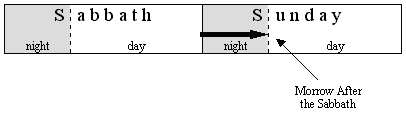
Here
it is pointed out that the basis for the phrase “Morrow After the Passover
Sacrifice” is the end of “14 Nissan.” However, the same people are correctly
emphasizing that the basis for said phrase, “Morrow After…,” is the “Passover
Sacrifice [14th at Twilight]” [not the 24 hour period of “14th
Nissan.”] True, the end of “14th Nissan” is more or less concurrent
in time with the “Passover Sacrifice,” yet it is the latter, the Sacrifice, and
not the former, the 14th, that constitutes the reference for the
phrase the “Morrow After the Passover Sacrifice.”
Bible
students should be well aware of the Scriptural emphasis on beginnings, e.g.
“God is One…,” “In the beginning God created…,” “and the first evening
[darkness] and the first day [light] were one day…,” etc., etc.. The God of the
Torah is first of all the Creator of Life, not the destroyer and the God of
Death, isn’t He? Thus, what sense would it make for the Torah to contradict
itself by all of a sudden basing the reckoning of Shavuot upon the end of a 24
hour day rather than upon its beginning?
Certainly while it is
true that the Passover Sacrifice is made at the end of the light portion of “14
Nissan,” it is also true that the Passover Sacrifice is made at the very
beginning of the dark portion of “15 Nissan.” And isn’t Passover Day, “14
Nissan” also sometimes referenced as a Preparation Day, just like the 6th
Day of the week is the weekly Day of Preparation? The important point of time
to observe and to focus upon is the beginning of the Shabbat (cf. Lev 23:3,)
not the end of the 6th Day, the Day of Preparation. In fact the end
of the 6th Day, strictly speaking, falls at the end of twilight,
while the beginning of the Shabbat begins with the first beginning of darkness,
which point in time may, strictly speaking, be applied to the astronomical
sunset which occurs a few minutes before the visible sunset. Thus, strictly
speaking, Shabbat begins before the end of the Sixth Day; there is an overlap
between the two days. The differences in time between the two points may be, at
times, more than one hour. Yet, observers of God’s Shabbat always give
precedence to that which pertains to the Shabbat, i.e. over and above that
which belongs to the 6th Day. Likewise, the important point in time
to focus upon re the Passover Sacrifice is the beginning of “15 Nissan” not the
end of “14 Nissan.”
Do you see the
apparently subtle difference re exact timing? And, do you see the not so subtle
differences re the consequences of reckoning one way vs. the other?!
One
of the differences may be perceived
by looking at Joshua 5:11 from two different points of view:
1)
Nehemia Gordon insists
(cashed)
that Hag HaOmer was brought on Abib 15 in that year of the crossing of the
Jordan.
2)
As of 5926[(*??*)] 09 26
2030 [2013-12-30], I
found that Hag HaOmer in the year of the crossing of the Jordan fell on
Abib 20, 1423 BCE, and that the people ate of the old crop of barley until the
Seventh Day Sabbath morning of Abib 20, 1423 BCE. (Cf. my prior stand at this
link.) However, an alternative
reading of Joshua
provides the Seventh Day Sabbath morning of Abib 21, 1423 BCE (cf. this link.)
This alternative scenario is consistent with the seven days of marching around
Jericho coinciding not only with the seven days of the regular week, but also
with the seven days of the Feast of Unleavened Bread! Furthermore, it is
consistent with the Lord speaking to Joshua (Joshua 1:1 & 5:9) on the
Seventh Day Sabbath. Likewise also for the Captain of the host of the Lord per
Joshua 5:13-6:5.
The Wave Sheaf
offering was always, i.e. per Torah instructions and as
observed by the prophet Daniel as well as by Jews generally in NT times, brought on a Shabbat.
Some questions for reflection in
consequence of the above &c.:
What
is the origin of Rosh HaShanah? Does it have a basis
in the Torah or not? (Nehemia Gordon has provided some valuable answers to
these questions in his article Yom Teruah How the Day of Shouting Became Rosh Hashanah.)
What
time of the year constitutes the true and scriptural beginning of a Shabbat
year? Aviv, Tishri, or the Eight Day, HaAzeret, the
22nd day of the Seventh Moon? The First moon, the Seventh moon, or
that something new, the Eight Day, following at the end of the Seventh Moon?
Spring or fall? What does the Torah teach? What did Moses and Aaron do, and for
how long, before the actual exodus out of
Is
“the first Sabbatical year out of eight”, being also “the first year of the 50
year Jubilee cycle,” beginning on the Day of Trumpets, on the eve when the 7th
new moon is first being seen, is it beginning at sunset at the new moon of Aviv
1, or is it beginning with the Eighth Day, HaAzeret,
at the time of sunset, moonset, and “the
end of the year?” And what about the conclusion of the 8th
Sabbatical year and the 50th year of Jubilee?
There
are only 49 full years, seven weeks of years, in a Jubilee cycle. Could it be
that Rosh HaShanah was originally applied only to the
latter of two consecutive Jubilee [half] years, i.e. the fiftieth and the
first, each of which years would then consist of six or seven moons, the first
one being six lunar cycles long, and the last one consisting of the remaining
six or seven lunar cycles? Or is Rosh HaShanah
merely a tradition of very recent origin (post-dispersion subsequent to the
fall of
Or
else is HaAzeret the closest we have to the beginning
of each year as originally instituted at the time of the Genesis creation
event?
Is
the light part of the Omer Reshit Shabbat, the “machar”, to be counted as the first day of fifty and as the
first Shabbat towards the Feast of Weeks? And what about the fiftieth day:
Should the dark part of the fiftieth day, the first 12 hours or so, be
considered the whole of the Feast of Weeks Shabbat? I believe the answer to
this last question is made clear in the above article.
Further,
Aviv 14, the Passover Day, the day preceding the first day of the seven day
long Feast of Unleavened Bread, though never numbered, is still the zeroeth day in that eight day festivity, while at the
opposite end of the hot part of the year the seven day long Feast of
Tabernacles is followed by an extra eighth day upon which one is restricted
from doing servile work. These extra days would necessarily serve as a reminder
to the people of how the days within each Feast are uniquely numbered in accord
with very specific rules. Could it be
that the Eighth Day at the conclusion of the Feast of Tabernacles and the zeroeth day, the Passover, are designed to point towards
each other as some kind of bridge tying the two half year periods together? Is
the name Passover an indication of such a tie? And what about the Eighth Day,
eight being recognized as a number connecting the last cycle of seven to
something new? As in the beginning of a new year, the
colder and darker portion of it? Or is the simple answer that Passover,
Aviv 14, is to be remembered as the last day of winter while the Eighth Day is
to be remembered as the first day of winter and the rainy season, i.e. are both
of these days an eighth day of sorts indicating the boundaries of a period of
time other than the season of most activity in an agricultural society and as
such corresponding to the contrasts of night vs. day?
Is
the absence of a unique Feast day on Aviv 1 an indication that this day is
merely a continuation of the year already approaching its middle portion – a
continuation of that wintery season which is not yet fully completed? ‑ Particularly
in view of, and in contrast to, the Torah instructions regarding the Day of
Trumpets announcing the Seventh and last Moon, the Sabbath Moon, of the year,
as naturally followed then by the Eighth Day announcing at “moonset” and “at the end of the year” something
new, a new year?
It
wouldn’t make much sense for anyone without an exceedingly generous heart to
sow their fields and reap any harvest in the fiftieth year, or even in the
forty-eighth year, if and when most, or all, of the proceeds would go to
another, would it?
On
the other hand there ought not be too much of a problem with Jubilee year
starvation if and when the Jubilee year is coinciding with a regular Shabbat
year, i.e. considering that the people would then be prepared for a double
sized harvest every seventh year, and would then have made provisions such that
they could enjoy a Sabbath year without any sowing or reaping every seventh
year, ought there? Additionally, they
would then likely be having a surplus in storage every year, i.e. seeing that
the capacity for two year storage would always be present, wouldn’t they? On the other hand, wouldn’t people be much
less likely to keep a three year surplus capacity for storage if such would be
used only about once in a life time, i.e. only once every fiftieth year?
END
P.S.
Please
do not hesitate to share with me any errors you find within. I have no desire to share with others
anything that is not in harmony with the Torah and therefore I remain most
grateful for any correction(s) you may share with me before this study is
shared with too many others.
Toda
raba!
Shalom
Comments
and donations freely accepted at:
Tree of Life©
c/o General Delivery
Nora [near SE-713 01]
eMail: TreeOfLifeTime@gmail.com
The GateWays into Tree of Life
Chronology Forums©
The GateWays into Tree of Life
Chronology©
The
GateWays of Entry into the Tree of Life Time
Chronology Touching upon the Book of Daniel©
Pearls & Mannah – “I
found it!”
Feel free to use, and for sharing freely with others,
any of the truth and blessings belonging to God alone. I retain all the copyrights
to the within, such that no one may lawfully restrain my use and my sharing of
it with others. Including also all the errors that remain. Please let only me
know about those. I need to know in order to correct them. Others don’t need to
be focused upon the errors that belong to me alone. Please respect that, and
please do not hesitate to let me know of any certain error that you find!
Without recourse. All Rights Reserved. Tree of Life©